Category: Uncategorized

  • Why Cocktail Glasses Break — and How to Spec Stemware That Lasts

    Why Cocktail Glasses Break — and How to Spec Stemware That Lasts

    A martini glass fails in one of three places, and none of them is the bowl you were admiring in the catalog. It chips at the rim, cracks at the stem, or splits from thermal shock in the dish pit. If you are buying stemware in bulk, the durability question is really three narrower questions about the glass, the rim, and how the glass is processed — and getting them right is what separates a case that lasts a season from one you are replacing by the dozen every month.

    Where stemware actually fails

    The rim is the most vulnerable part of any glass. It is the thinnest section, it makes first contact with faucets, racks, and other glasses, and a single chip pulls the piece from service for hygiene reasons. The stem is the second weak point: it concentrates the leverage of a full bowl into a narrow column, so any flaw there tends to find it. And thermal shock is the quiet third cause, cracking a glass that survived every impact simply because it went from a hot wash to a bin of ice too quickly. Every choice below is really about reinforcing one of these three points.

    Soda-lime or crystal: the material sets the ceiling

    Most commercial glassware is soda-lime glass, made from sand, soda ash, and limestone. It is affordable, consistent, and the sensible default for high-volume bars that expect to lose glasses to ordinary accidents. Lead-free crystal, sometimes branded as crystalline, replaces the old lead content with additives that let the glass be spun thinner while staying brilliantly clear, with better clarity and a finer rim than soda-lime can achieve. The trade-off is delicacy: a thin crystal bowl and sheer rim present beautifully but chip more easily unless the maker reinforces them. The material you pick sets the ceiling on both how refined the glass looks and how much abuse it can take.

    Tempering: rim, full, or none

    How a glass is cooled after forming matters as much as what it is made of. Annealed glass is cooled slowly to remove internal stress; it is the most affordable and, when it does break, it tends to come apart in a few large pieces that are easy to clear. Fully tempered glass is heated past its strain point and cooled fast, which raises impact strength substantially — published foodservice guidance puts it at roughly two to four times annealed — but it carries a real caveat for a bar: when it finally fails it can shatter violently into tiny shards, exactly the wrong behavior near an ice bin or a guest’s hand. Rim-tempered glass is the common compromise, concentrating extra strength at the rim where damage starts while keeping the safer break behavior of annealed glass elsewhere.
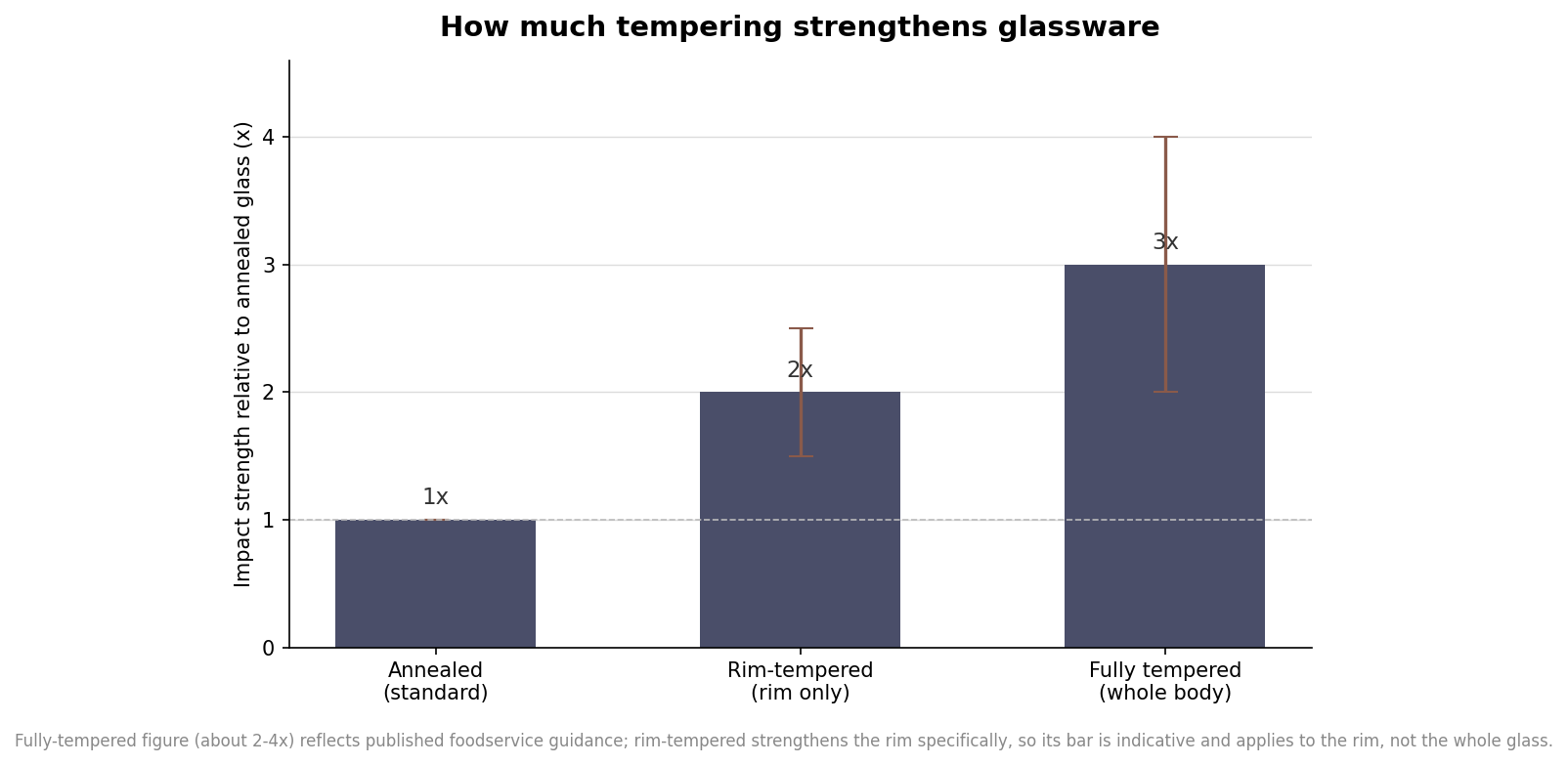
    Bar chart of impact strength relative to annealed glass, with fully tempered about two to four times stronger and rim-tempered in between
    Tempering trades strength for break behavior; rim-tempering hardens the part that chips without the shard hazard of full tempering.

    Read the chart as a strength-versus-safety story rather than a simple ranking. Fully tempered is the strongest on paper, but many operators deliberately choose rim-tempered stemware because it hardens the part that actually chips without turning a dropped glass into a shard hazard. For a martini glass that lives around ice and citrus, that trade usually favors the rim-tempered option.

    Stem construction and rim treatment

    Two construction details quietly decide how long a glass lasts. The first is whether the stem is pulled as one piece or joined. A pulled stem is drawn from the same gob of glass as the bowl, leaving no seam; a stem that is formed separately and joined introduces a weld line that becomes a stress point under the leverage of a full bowl. One-piece stems are the more durable choice for service, and machine-made stemware tends to hold tighter, more repeatable tolerances than hand-finished pieces.

    The second detail is the rim treatment. A beaded rim is slightly rolled and thicker, which adds chip resistance at the cost of a heavier lip that some tasters feel changes the drink’s approach. A sheer, beadless rim looks elegant and pours cleanly but is more fragile unless the glass is crystal or the rim is reinforced. Neither is wrong; the beaded rim leans toward durability and the sheer rim toward presentation, and the right pick depends on whether the glass is a workhorse or a showpiece.

    How to spec for your service

    Bring the choices together against how the glass will actually live. A high-volume cocktail bar running glasses through a machine dozens of times a night is well served by rim-tempered soda-lime with a one-piece stem, accepting a slightly heavier look in exchange for fewer chips. A fine-dining room presenting a signature martini can justify lead-free crystal with a sheer rim, provided staff handle it gently and let it cool before it meets ice. The positioning chart below sketches that trade-off across common builds.
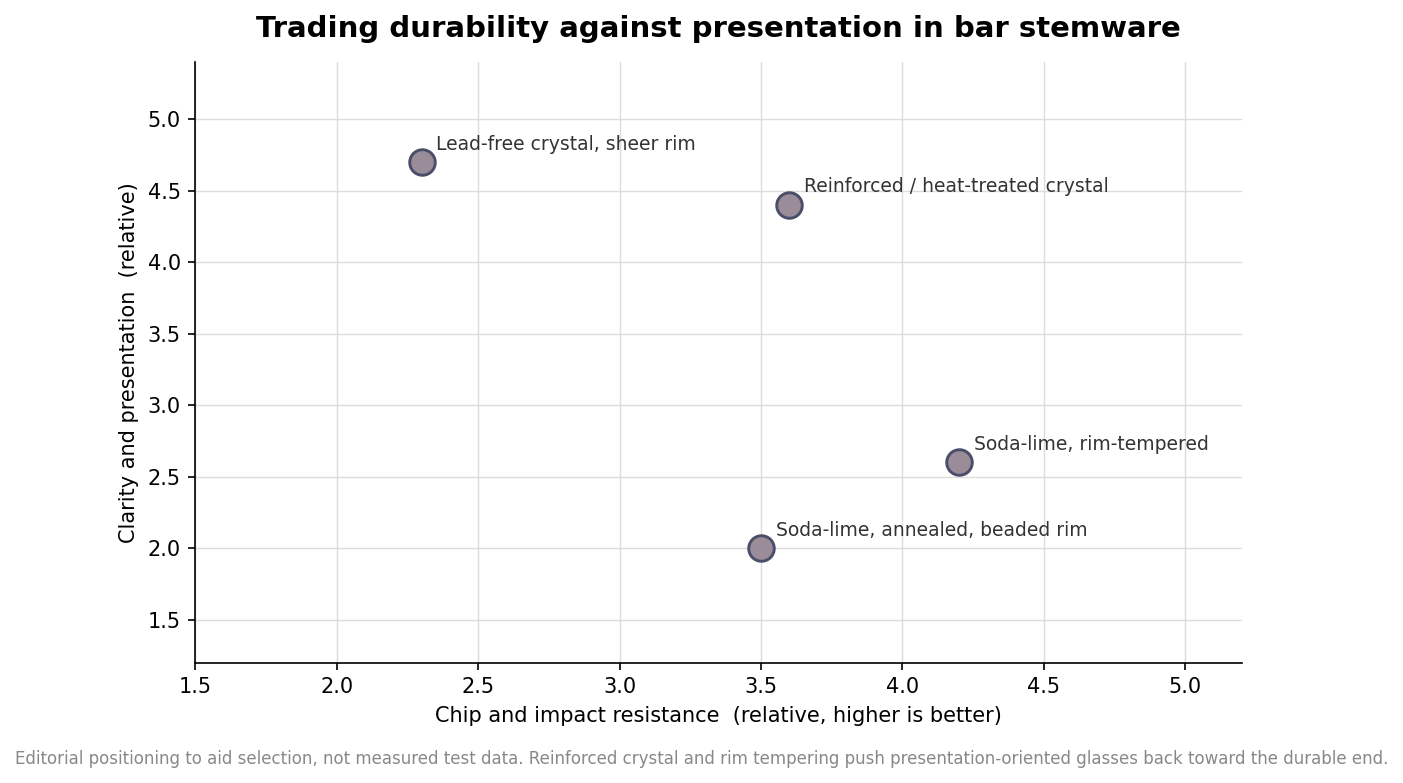
    Scatter plot positioning glassware builds by chip resistance versus clarity and presentation
    Editorial positioning of common builds: reinforced crystal and rim tempering recover durability without giving up much presentation.

    Whatever you choose, control the thermal-shock risk in the wash: let glasses settle toward room temperature after the machine before you fill them with ice, and never pour a cold drink into a glass straight from a hot cycle. It is also worth asking a supplier whether the line carries a rim-and-foot chip guarantee, since those programs exist specifically because the rim and foot are where stemware dies. Finally, order a small sample and run it through your real glasswasher and racks for a week before committing to a full order — the dish pit, not the showroom, is where a martini glass proves whether it was worth buying.
  • How to Specify Martini Glass Capacity: Pour, Headspace, and Yield

    How to Specify Martini Glass Capacity: Pour, Headspace, and Yield

    Most people order custom martini glasses by shape and decoration and treat capacity as an afterthought. That is backward. Capacity is what decides whether your cocktail looks generous or stingy, whether staff can carry a full tray without a spill, and how many drinks you pour from a bottle at a busy event. This is a walkthrough for specifying the right size, starting from the drink and working out to the glass, so the number you put on the order sheet is deliberate rather than inherited from a catalog default.

    Start with the drink, not the glass

    A classic martini is a small drink. Two and a half ounces of gin with a half ounce of vermouth lands at roughly 3 to 3.5 ounces of liquid, served up with no ice. That is the number that should anchor everything else. If your program is built around classic stirred and shaken cocktails, you are pouring three-ish ounces and the glass exists to frame that pour, keep it cold, and give a hand somewhere to hold. If instead you are serving espresso martinis with a thick crema, or oversized signature cocktails, the working volume climbs toward 5 or 6 ounces and the glass has to grow with it. Decide which drink defines your service before you look at a single glass, because that choice sets the floor on capacity.

    Capacity is not the same as usable pour

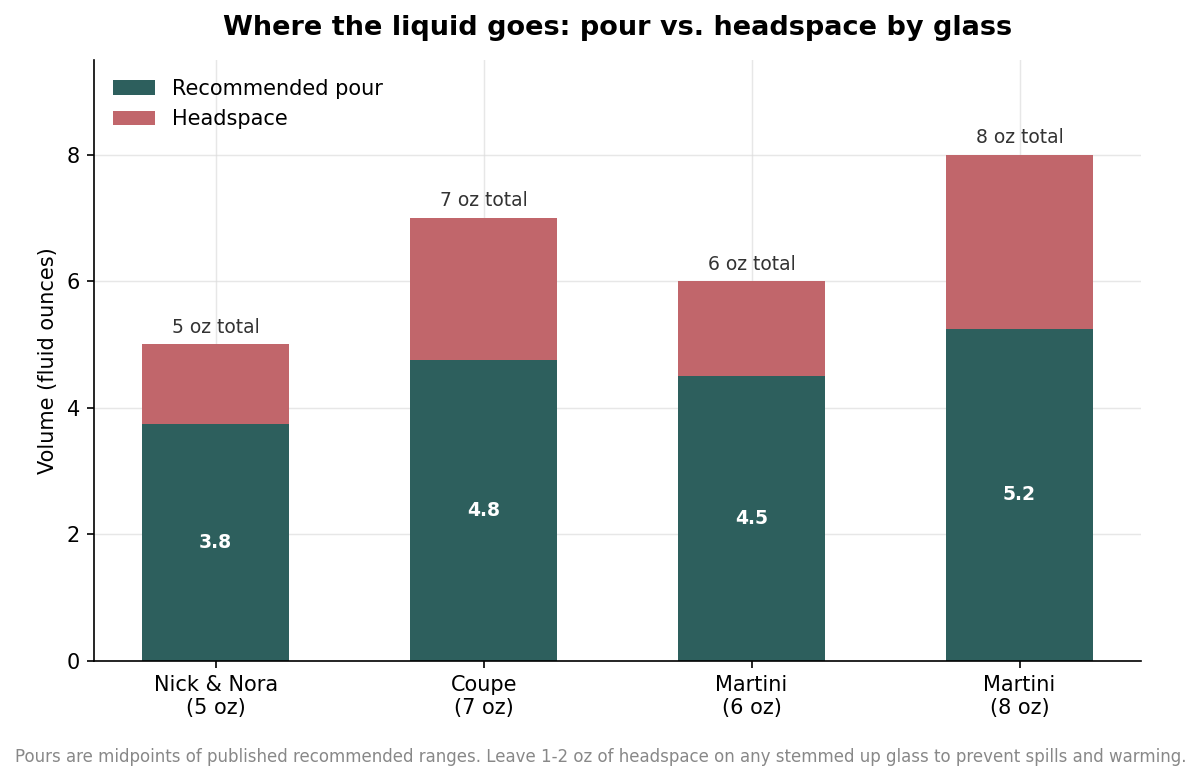
    The number stamped on a glass is its total capacity filled to the brim, which is never how you serve it. Every stemmed up glass needs headspace so the drink does not slosh over the rim when it is carried, and so a cold cocktail is not sitting warm against a full rim. The working guidance is to leave 1 to 2 ounces of headroom. That is why an eight-ounce martini glass is a sensible vessel for a five-ounce drink and a slightly generous one for a classic three-ounce pour. When you compare quotes and samples, read the recommended pour, not just the brim capacity, or you will end up with glasses that look half empty in service.

    Stacked bar chart showing recommended pour and headspace adding up to total capacity for Nick and Nora, coupe, and martini glasses
    Total capacity is split between the drink and the headspace you leave above it; usable pour is well below brim volume.

    The size ladder, from 5 to 8 ounces

    Stemmed cocktail glasses cluster into a predictable ladder. A Nick and Nora holds about 5 ounces and pours cleanly at 3.5 to 4, which makes it the tidiest match for a classic martini and the reason craft bars favor it. A coupe spans 5 to 9 ounces, most commonly around 7, and pours 4 to 5.5, giving it flexibility across shaken drinks and sparkling service. The traditional V-bowl martini glass runs 6 to 8 ounces, with a standard reference glass measuring about 6.875 inches tall and 4.875 inches across the bowl at an 8-ounce capacity. Historically the original cocktail glasses held only about 4 ounces, and the swing back toward smaller sizes in craft bars is a direct response to larger bowls letting drinks go warm before the last sip. Glasses do run far larger, up to 24 ounces for novelty and frozen service, but those are a different product with different stability trade-offs.

    Specify for throughput, not just the pour

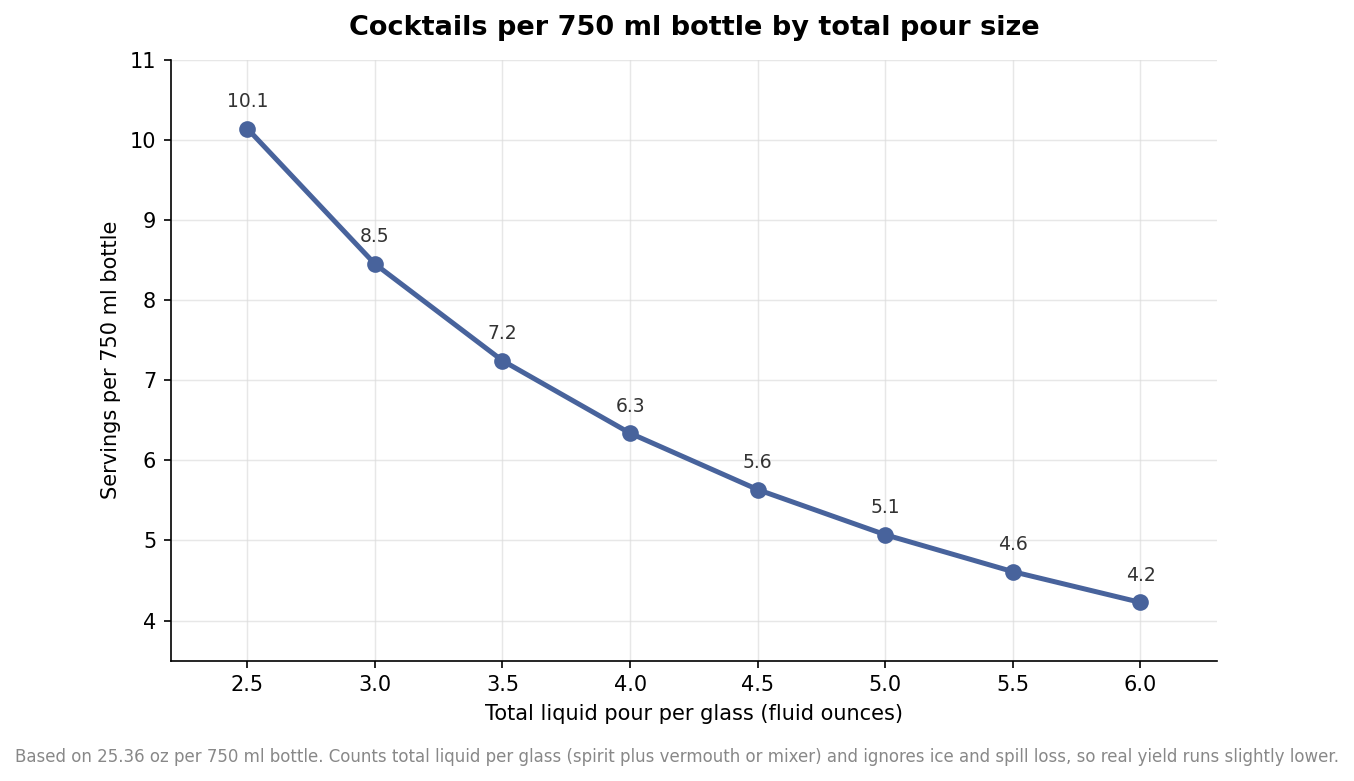
    Capacity also drives economics at scale, because pour size determines how many drinks come out of a bottle. A standard 750 ml bottle holds about 25.4 ounces. Pour a lean 2.5 ounces and you get roughly ten drinks from it; pour a generous 5 ounces and you get about five. For a catered event with a fixed bar budget, that difference compounds fast across a case of spirits. Sizing the glass so that a controlled, correct pour still looks full is the lever here: a glass that is too large tempts overpouring to avoid a stingy look, quietly halving your yield. Match the glass to the intended pour and the pour to the drink, and the throughput math takes care of itself.

    Line chart of cocktails yielded per 750 ml bottle as total pour size increases from 2.5 to 6 ounces
    Yield per bottle falls sharply as pour size grows, from about ten drinks at 2.5 oz to five at 5 oz.

    Rim, bowl, and the practical details

    Two physical dimensions ride along with capacity and deserve their own attention. The first is rim diameter. A standard V-bowl martini glass measures close to 4.875 inches across, and that wide opening is both a feature and a liability: it presents the drink beautifully and cools it fast, but it also spills readily and exposes more surface to warming. The second is the bowl face itself, which is your decoration canvas. A wider, taller bowl gives a printer or etcher more usable area for a logo, but the same curve that makes the glass elegant distorts artwork, so a larger bowl is not automatically an easier one to brand. If storage is tight, ask whether the glass is stackable, because the classic wide V-bowl generally is not and will claim more shelf and case space than a narrower coupe. None of these details change the drink, but they change the day-to-day of running the glass, and they are cheaper to get right on the order sheet than to discover after a thousand units arrive.

    Balancing capacity against stability and cost

    Bigger bowls are less forgiving. As capacity climbs, the bowl gets wider and the center of gravity rises, so large martini glasses tip more easily on a crowded tray and stress the stem when carried. If your setting is a standing reception rather than a seated dinner, a slightly smaller, lower-capacity bowl earns its keep in fewer breakages. Cost tracks capacity and finish rather than decoration alone: basic customizable martini and cocktail glasses run roughly $0.83 to $2.58 each in case quantities, while specialty shapes, colored rims, and crystal climb to $4 to $11 or beyond. Printing or etching is a separate line on top of the base glass, so the capacity and material you choose set the foundation of your per-glass cost before any branding is added. Those figures are case-quantity retail prices seen in mid-2026 and will move with material and freight, so treat them as bands. Specify the capacity first, confirm the recommended pour matches your drink, and only then move on to shape and decoration.

  • Martini, Coupe or Nick & Nora?

    Three profiles, three genuinely different jobs. Most venues own the wrong one because they inherited it.

    The martini V

    Iconic, and impractical. A wide shallow V has a high centre of gravity and a large open surface, so it spills at the slightest knock and loses aromatics immediately.

    It is also usually too big. Modern V-bowls run around seven ounces, and a correctly built cocktail is about three, so the drink looks mean unless you overpour it.

    The coupe

    The same capacity sitting much lower, so it is far harder to tip — which is why bars serving across a room on trays keep moving to it.

    It also gives you more usable branding area, because the gentler curve lets a mark sit flatter and read from further away without distorting.

    The Nick & Nora

    Small, stemmed, tulip-bowled, and simply the right size for a properly built drink. Three ounces fills it generously instead of looking lost.

    The tulip shape also holds aromatics far better than an open V, which for anything stirred and spirit-forward is most of the point.

    And stemless

    A separate decision driven by breakage rather than elegance. It removes the part that snaps and racks far more densely, at the cost of warming the drink faster because the hand sits on the bowl. In a high-volume room the arithmetic usually decides it.

  • Etched, Fired or Coated? What Survives a Glasswasher

    Branded glassware fails in a completely predictable way, and the failure is always the decoration rather than the glass.

    Sand-etching

    A mask is cut and the exposed glass is blasted, so the mark is a physical change to the surface. There is nothing on top to wear through, which is why an etched glass looks identical after two years of nightly service.

    The cost is colour. Etching is always a frosted white mark and always will be. Any supplier offering a coloured etch is describing something else, usually a coating applied into the etch, which fails like any other coating.

    Kiln-fired ceramic ink

    Pigment printed onto the glass and then fired, which fuses it to the surface. It gives you full colour, including fired gold and platinum, and it survives commercial washing.

    This is the option to insist on if colour matters. It costs more than the alternatives, and the gap is exactly why the alternatives exist.

    Vinyl and air-dried inks

    Both are coatings. Vinyl lifts at the edges; air-dried organic ink crazes into a fine network of cracks, then ghosts, then flakes. Domestic dishwashers are survivable for a while. Commercial glasswashers are not.

    If a quote for printed glassware is dramatically cheaper than the rest, this is almost always the reason, and it is worth asking the question directly.

    How to test a sample

    Ask for a decorated sample and put it through your own glasswasher thirty times before you commit to a thousand. Any supplier confident in their method will encourage this. We do.

  • Why Your Logo Looks Wrong on a Curved Glass

    Artwork is designed flat and applied to a compound curve. Everything surprising about branded glassware comes from that one fact.

    Wide marks distort, narrow ones do not

    The wider a mark runs around a bowl, the more the ends curve away from the viewer, so a long horizontal wordmark reads as though it is bending — because it is.

    Stacking a long name onto two shorter lines fixes it almost every time, and costs nothing.

    Mind the grip line

    On a stemless glass the hand sits on the bowl, so a centred mark spends most of its life under someone’s fingers. Set it lower. On stemware the equivalent mistake is a mark on the foot, which is invisible whenever the glass is being held.

    Scale per profile, do not reuse

    A file sized for a coupe reads cramped on a Nick & Nora and lost on a large V. These are different bowls, not different sizes of the same bowl, and artwork should be rescaled for each rather than shrunk.

    We do that as part of the free mockup and show it on the actual curve, not flat.

    Fine linework is fine, actually

    One thing that surprises people: sand-etching holds much finer detail on glass than most decoration methods hold on other substrates. If your mark has delicate linework, etching is usually the method that keeps it.

  • Martini Glass vs Coupe vs Nick & Nora: Which Shape to Order

    Martini Glass vs Coupe vs Nick & Nora: Which Shape to Order

    The martini glass, the coupe, and the Nick & Nora all do the same fundamental job: they hold a stirred or shaken cocktail with no ice, on a stem, so the drink stays cold and the hand stays off the bowl. Yet they are not interchangeable. Each shape changes how the drink behaves, how easily it spills, and how a custom mark sits on the glass. If you are ordering glassware to engrave or brand, the shape decision comes first, because it sets everything from pour size to where a logo can live.

    Three glasses, three lineages

    The martini glass is the wide V-cone everyone pictures. Its steep, open walls and broad rim make it the most theatrical of the three and the reason “up” drinks read as celebratory. That drama comes at a cost in stability, which is the trade the shape asks you to accept. The coupe, by contrast, is a shallow rounded saucer with a lineage in early sparkling-wine service; its wide but curved bowl suits shaken, frothy drinks and Champagne alike. The Nick & Nora is the newest revival of an old idea, a small bell-shaped bowl with an inward-curving rim that bartender Dale DeGroff reintroduced at New York’s Rainbow Room in 1987 after finding a 1930s “Little Martini” design.

    Understanding the lineage helps because it explains the proportions. The martini glass was drawn to be seen across a room, the coupe to cradle bubbles and foam, and the Nick & Nora to hold a spirit-forward drink close and contained. None is objectively best; each optimizes for a different priority.

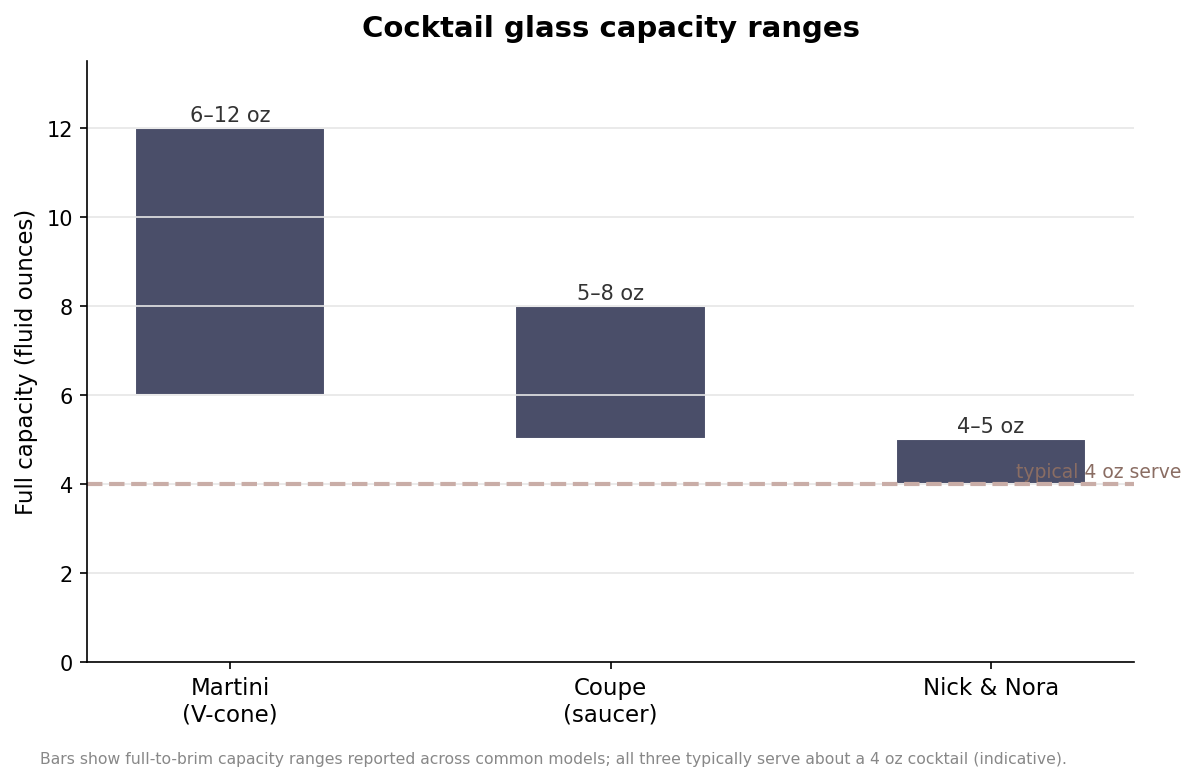
    Column chart of capacity ranges for martini, coupe, and Nick and Nora glasses with a typical 4 ounce serve line
    Full capacities vary widely even though all three usually serve about four ounces.

    Capacity and the four-ounce truth

    All three typically serve about a four-ounce cocktail, but their full capacities differ sharply. A martini glass commonly holds anywhere from six to twelve ounces to the brim, with vintage examples closer to five. A coupe runs roughly five to eight ounces, and a Nick & Nora is the smallest at about four to five ounces, close to 150 milliliters. Since the drink itself is usually the same size, the difference between these glasses is mostly empty space above the liquid.

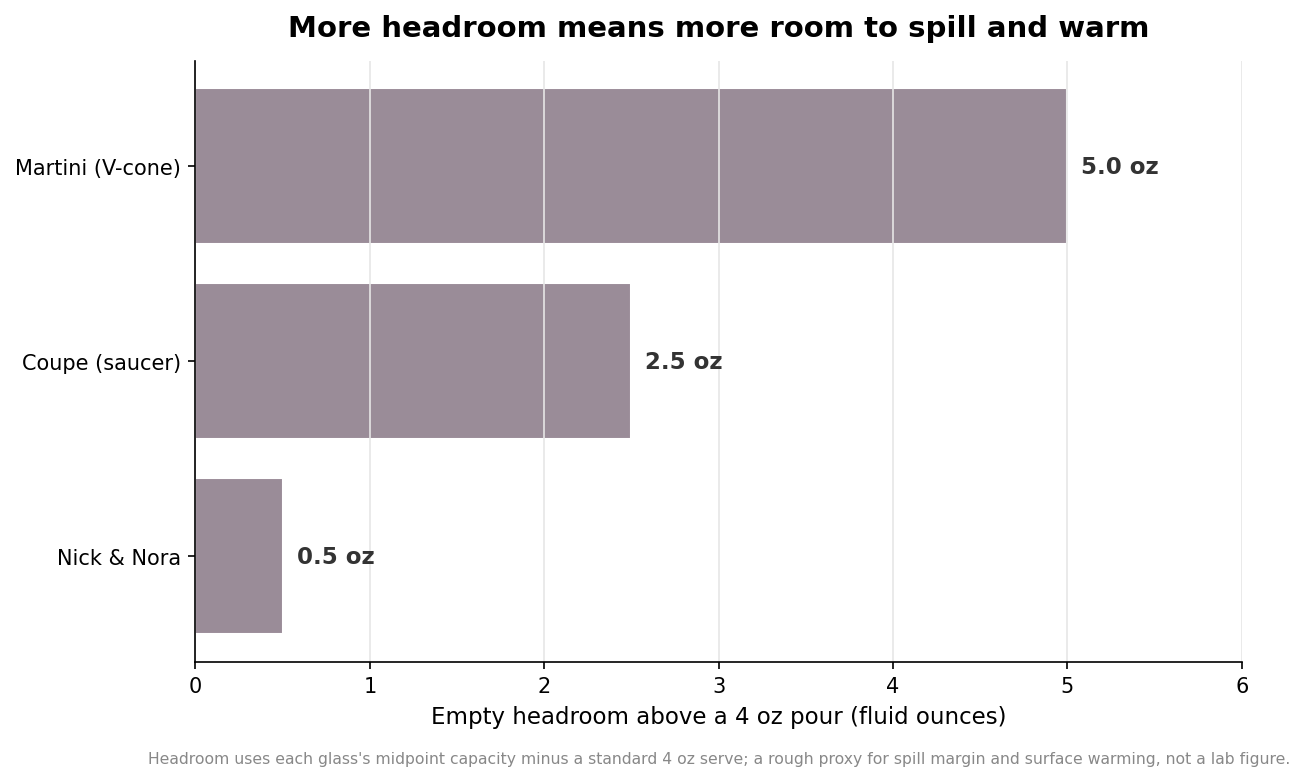
    That headroom is not neutral. A larger, more open bowl exposes more surface area to the warm air of the room, so the same drink loses its chill faster in a big martini glass than in a snug Nick & Nora. Headroom also correlates with how much slosh a glass can absorb before it goes over the rim. The four-ounce serve is the constant; the shape decides how much of the glass sits empty around it.

    Horizontal bar chart of empty headroom above a 4 ounce pour for each glass shape
    The open martini bowl leaves the most empty space, a rough proxy for spill and warming.

    Spill, aroma, and temperature

    The inward or outward turn of the rim is the single most consequential detail. The martini glass flares outward, which looks striking but gives a full drink almost nowhere to go when the glass tips, so it earns its reputation as the most spill-prone of the three. The Nick & Nora curves inward at the mouth, which contains the liquid, traps aromatics over the surface, and slows warming, making it the steadiest choice for a busy service or a standing event. The coupe lands in the middle: more forgiving than the V-cone, more open than the Nick & Nora, and especially good at showing off the foam cap on an espresso martini or a sour.

    For aroma-driven, spirit-forward drinks such as a Manhattan or a classic gin martini, the containment of a Nick & Nora or the focus of a narrower martini bowl concentrates the nose. For anything shaken to a froth or served with sparkling wine, the coupe’s width lets the texture breathe. Matching rim shape to the drink is a small choice that guests feel without being able to name.

    Which shape takes a custom mark best

    Shape also dictates where personalization can go and how large it can be. The martini glass offers the most generous, near-flat exterior panel on its bowl, which is why it is a favorite for larger engraved monograms, wedding dates, and bar logos that need to read from a distance. The coupe’s rounded bowl curves in every direction, so art wraps rather than sits flat and usually works best as a smaller, centered mark or a band near the rim. The Nick & Nora’s compact bowl limits the printable or engraved area, favoring a single tidy initial or a small emblem over anything busy.

    Stem and base matter for durability of any decoration as much as the bowl does. Taller, thinner stems photograph beautifully but are more vulnerable in high-volume washing, while a slightly heavier base survives frequent handling. If glasses will be customized and then used hard in a commercial bar, weigh the decoration surface against how the glass will actually be stored and cleaned, not just how it looks on the shelf.

    Choosing for your bar, event, or gift

    Put the three side by side and the decision usually resolves quickly. Choose the martini glass when presentation and a bold custom mark are the point and service is unhurried, as at a reception or a photographed event. Choose the coupe when the menu leans on shaken, frothy, or sparkling drinks and you want a versatile bowl that also doubles for Champagne. Choose the Nick & Nora when you want the most spill-resistant, temperature-holding option for spirit-forward cocktails or for events where guests will be moving and standing.

    If you can only order one shape to customize, the coupe is the most flexible across drink styles, while the Nick & Nora is the most practical for real-world durability and the martini glass is the most striking for branding. Decide which of those three priorities matters most for your use, and the glass, and the way you personalize it, follows naturally.