Most people order custom martini glasses by shape and decoration and treat capacity as an afterthought. That is backward. Capacity is what decides whether your cocktail looks generous or stingy, whether staff can carry a full tray without a spill, and how many drinks you pour from a bottle at a busy event. This is a walkthrough for specifying the right size, starting from the drink and working out to the glass, so the number you put on the order sheet is deliberate rather than inherited from a catalog default.
Start with the drink, not the glass
A classic martini is a small drink. Two and a half ounces of gin with a half ounce of vermouth lands at roughly 3 to 3.5 ounces of liquid, served up with no ice. That is the number that should anchor everything else. If your program is built around classic stirred and shaken cocktails, you are pouring three-ish ounces and the glass exists to frame that pour, keep it cold, and give a hand somewhere to hold. If instead you are serving espresso martinis with a thick crema, or oversized signature cocktails, the working volume climbs toward 5 or 6 ounces and the glass has to grow with it. Decide which drink defines your service before you look at a single glass, because that choice sets the floor on capacity.
Capacity is not the same as usable pour
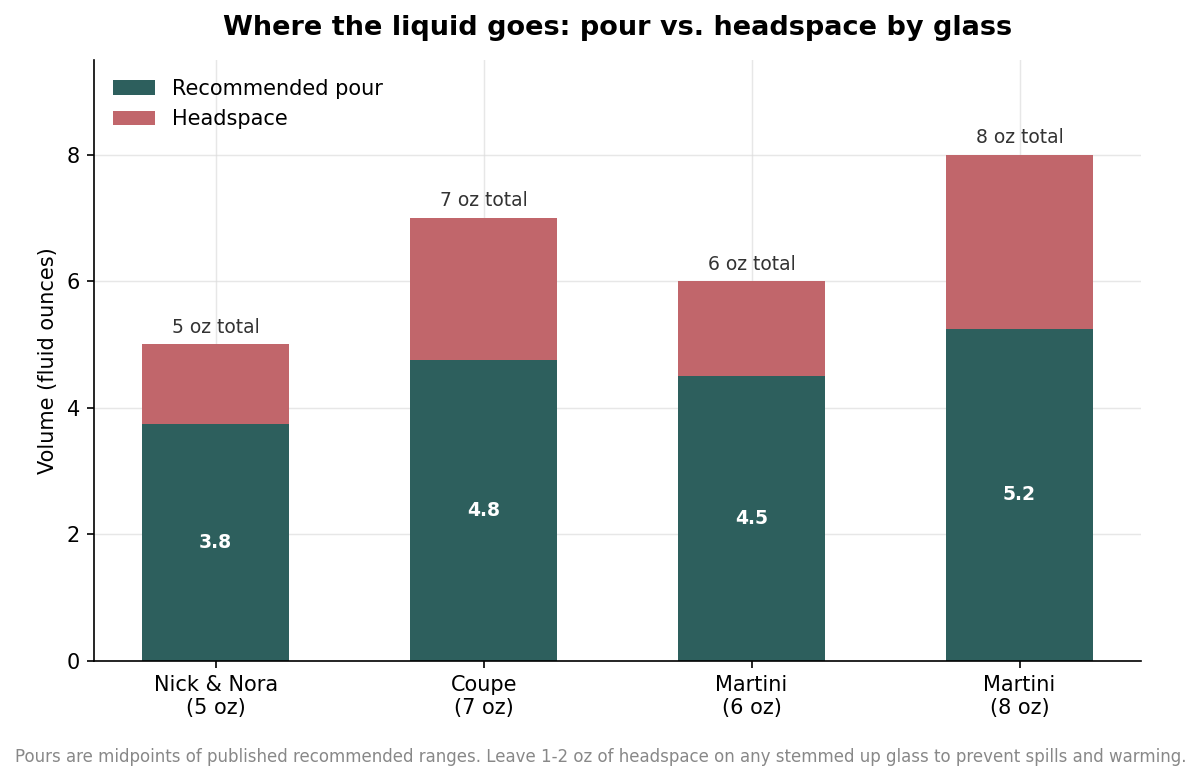
The number stamped on a glass is its total capacity filled to the brim, which is never how you serve it. Every stemmed up glass needs headspace so the drink does not slosh over the rim when it is carried, and so a cold cocktail is not sitting warm against a full rim. The working guidance is to leave 1 to 2 ounces of headroom. That is why an eight-ounce martini glass is a sensible vessel for a five-ounce drink and a slightly generous one for a classic three-ounce pour. When you compare quotes and samples, read the recommended pour, not just the brim capacity, or you will end up with glasses that look half empty in service.
The size ladder, from 5 to 8 ounces
Stemmed cocktail glasses cluster into a predictable ladder. A Nick and Nora holds about 5 ounces and pours cleanly at 3.5 to 4, which makes it the tidiest match for a classic martini and the reason craft bars favor it. A coupe spans 5 to 9 ounces, most commonly around 7, and pours 4 to 5.5, giving it flexibility across shaken drinks and sparkling service. The traditional V-bowl martini glass runs 6 to 8 ounces, with a standard reference glass measuring about 6.875 inches tall and 4.875 inches across the bowl at an 8-ounce capacity. Historically the original cocktail glasses held only about 4 ounces, and the swing back toward smaller sizes in craft bars is a direct response to larger bowls letting drinks go warm before the last sip. Glasses do run far larger, up to 24 ounces for novelty and frozen service, but those are a different product with different stability trade-offs.
Specify for throughput, not just the pour
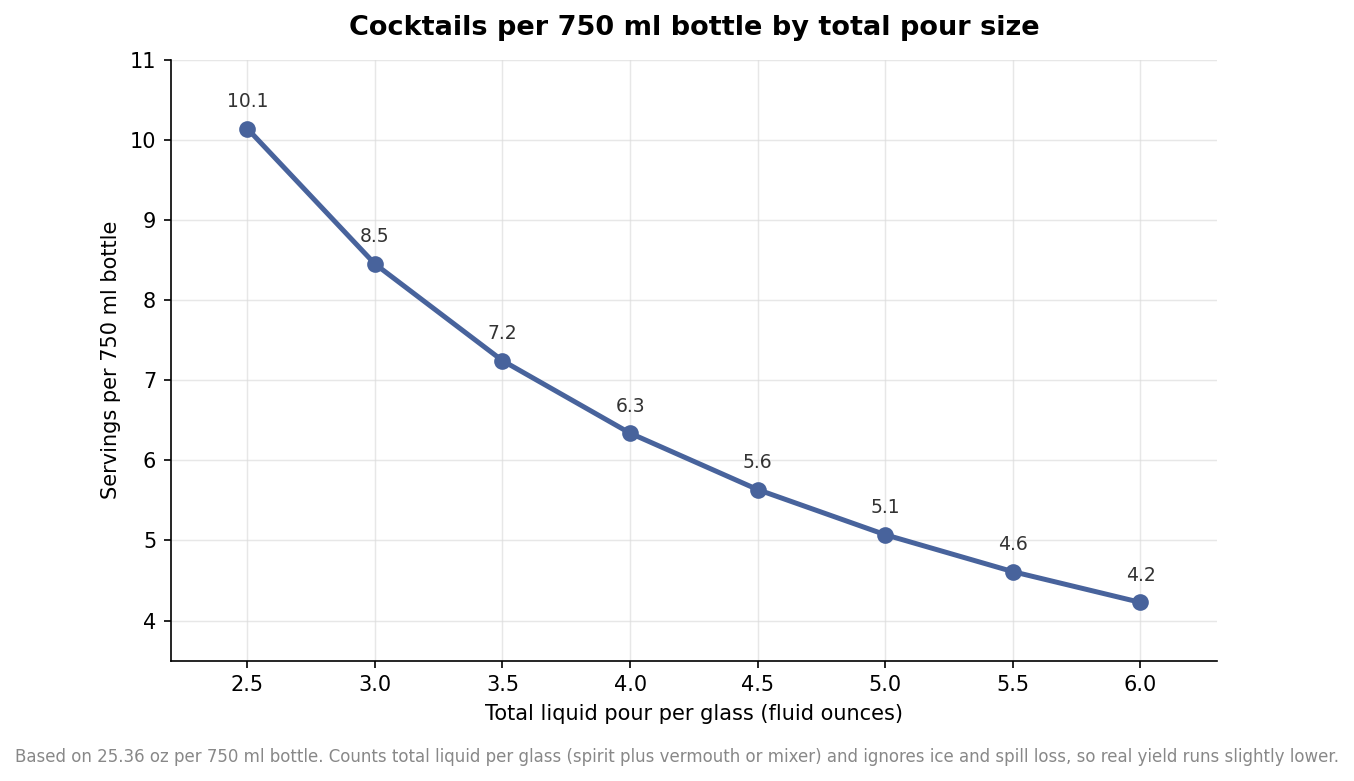
Capacity also drives economics at scale, because pour size determines how many drinks come out of a bottle. A standard 750 ml bottle holds about 25.4 ounces. Pour a lean 2.5 ounces and you get roughly ten drinks from it; pour a generous 5 ounces and you get about five. For a catered event with a fixed bar budget, that difference compounds fast across a case of spirits. Sizing the glass so that a controlled, correct pour still looks full is the lever here: a glass that is too large tempts overpouring to avoid a stingy look, quietly halving your yield. Match the glass to the intended pour and the pour to the drink, and the throughput math takes care of itself.
Rim, bowl, and the practical details
Two physical dimensions ride along with capacity and deserve their own attention. The first is rim diameter. A standard V-bowl martini glass measures close to 4.875 inches across, and that wide opening is both a feature and a liability: it presents the drink beautifully and cools it fast, but it also spills readily and exposes more surface to warming. The second is the bowl face itself, which is your decoration canvas. A wider, taller bowl gives a printer or etcher more usable area for a logo, but the same curve that makes the glass elegant distorts artwork, so a larger bowl is not automatically an easier one to brand. If storage is tight, ask whether the glass is stackable, because the classic wide V-bowl generally is not and will claim more shelf and case space than a narrower coupe. None of these details change the drink, but they change the day-to-day of running the glass, and they are cheaper to get right on the order sheet than to discover after a thousand units arrive.
Balancing capacity against stability and cost
Bigger bowls are less forgiving. As capacity climbs, the bowl gets wider and the center of gravity rises, so large martini glasses tip more easily on a crowded tray and stress the stem when carried. If your setting is a standing reception rather than a seated dinner, a slightly smaller, lower-capacity bowl earns its keep in fewer breakages. Cost tracks capacity and finish rather than decoration alone: basic customizable martini and cocktail glasses run roughly $0.83 to $2.58 each in case quantities, while specialty shapes, colored rims, and crystal climb to $4 to $11 or beyond. Printing or etching is a separate line on top of the base glass, so the capacity and material you choose set the foundation of your per-glass cost before any branding is added. Those figures are case-quantity retail prices seen in mid-2026 and will move with material and freight, so treat them as bands. Specify the capacity first, confirm the recommended pour matches your drink, and only then move on to shape and decoration.