The martini glass, the coupe, and the Nick & Nora all do the same fundamental job: they hold a stirred or shaken cocktail with no ice, on a stem, so the drink stays cold and the hand stays off the bowl. Yet they are not interchangeable. Each shape changes how the drink behaves, how easily it spills, and how a custom mark sits on the glass. If you are ordering glassware to engrave or brand, the shape decision comes first, because it sets everything from pour size to where a logo can live.
Three glasses, three lineages
The martini glass is the wide V-cone everyone pictures. Its steep, open walls and broad rim make it the most theatrical of the three and the reason “up” drinks read as celebratory. That drama comes at a cost in stability, which is the trade the shape asks you to accept. The coupe, by contrast, is a shallow rounded saucer with a lineage in early sparkling-wine service; its wide but curved bowl suits shaken, frothy drinks and Champagne alike. The Nick & Nora is the newest revival of an old idea, a small bell-shaped bowl with an inward-curving rim that bartender Dale DeGroff reintroduced at New York’s Rainbow Room in 1987 after finding a 1930s “Little Martini” design.
Understanding the lineage helps because it explains the proportions. The martini glass was drawn to be seen across a room, the coupe to cradle bubbles and foam, and the Nick & Nora to hold a spirit-forward drink close and contained. None is objectively best; each optimizes for a different priority.
Capacity and the four-ounce truth
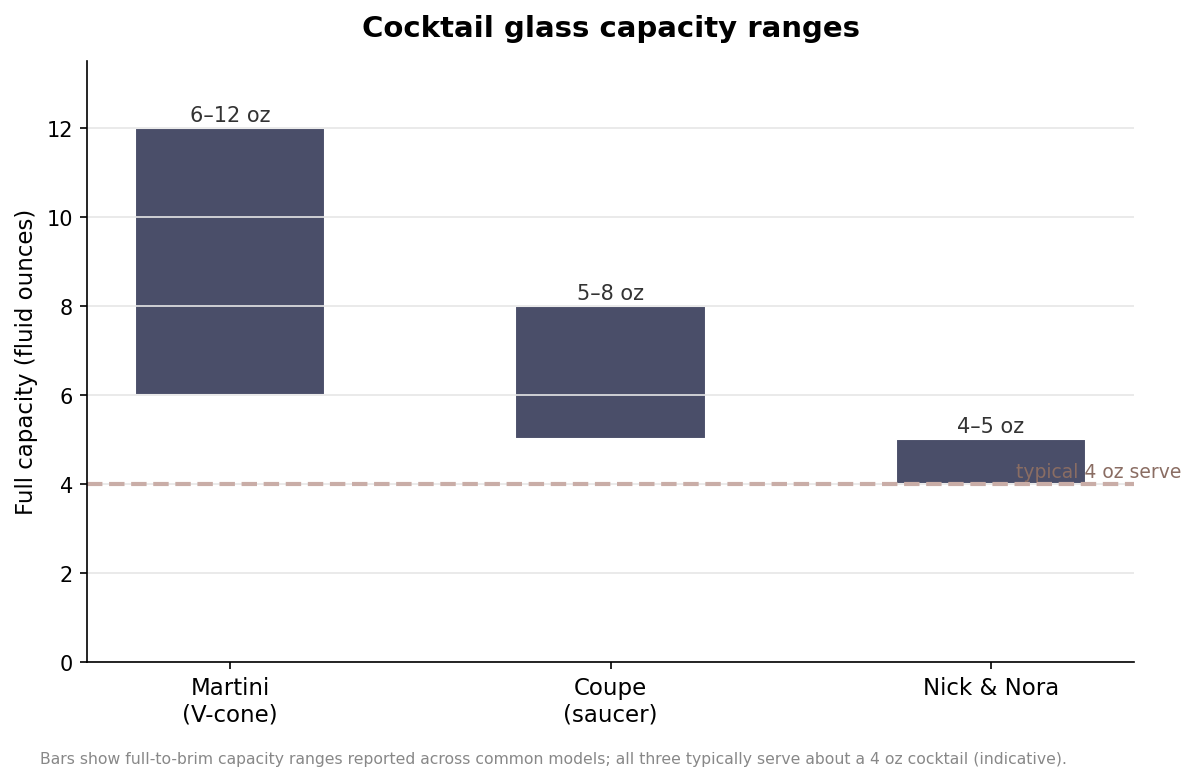
All three typically serve about a four-ounce cocktail, but their full capacities differ sharply. A martini glass commonly holds anywhere from six to twelve ounces to the brim, with vintage examples closer to five. A coupe runs roughly five to eight ounces, and a Nick & Nora is the smallest at about four to five ounces, close to 150 milliliters. Since the drink itself is usually the same size, the difference between these glasses is mostly empty space above the liquid.
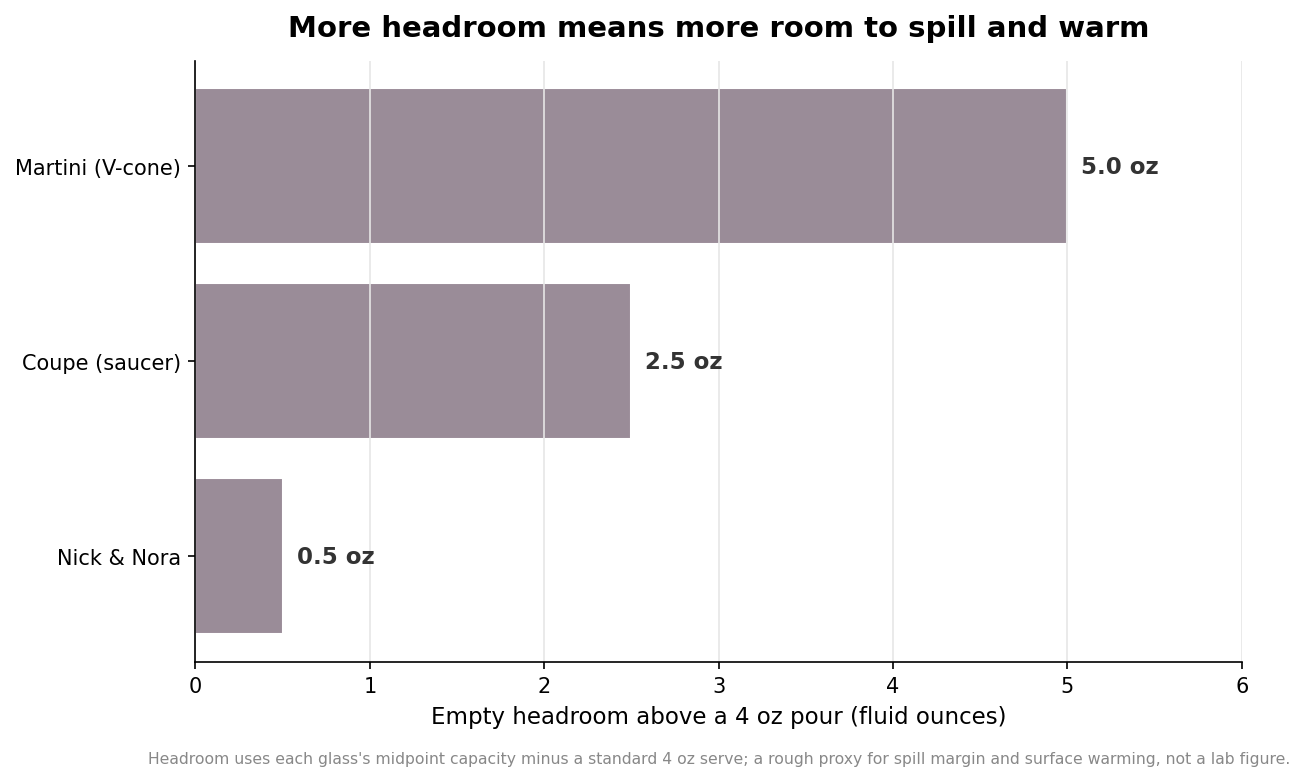
That headroom is not neutral. A larger, more open bowl exposes more surface area to the warm air of the room, so the same drink loses its chill faster in a big martini glass than in a snug Nick & Nora. Headroom also correlates with how much slosh a glass can absorb before it goes over the rim. The four-ounce serve is the constant; the shape decides how much of the glass sits empty around it.
Spill, aroma, and temperature
The inward or outward turn of the rim is the single most consequential detail. The martini glass flares outward, which looks striking but gives a full drink almost nowhere to go when the glass tips, so it earns its reputation as the most spill-prone of the three. The Nick & Nora curves inward at the mouth, which contains the liquid, traps aromatics over the surface, and slows warming, making it the steadiest choice for a busy service or a standing event. The coupe lands in the middle: more forgiving than the V-cone, more open than the Nick & Nora, and especially good at showing off the foam cap on an espresso martini or a sour.
For aroma-driven, spirit-forward drinks such as a Manhattan or a classic gin martini, the containment of a Nick & Nora or the focus of a narrower martini bowl concentrates the nose. For anything shaken to a froth or served with sparkling wine, the coupe’s width lets the texture breathe. Matching rim shape to the drink is a small choice that guests feel without being able to name.
Which shape takes a custom mark best
Shape also dictates where personalization can go and how large it can be. The martini glass offers the most generous, near-flat exterior panel on its bowl, which is why it is a favorite for larger engraved monograms, wedding dates, and bar logos that need to read from a distance. The coupe’s rounded bowl curves in every direction, so art wraps rather than sits flat and usually works best as a smaller, centered mark or a band near the rim. The Nick & Nora’s compact bowl limits the printable or engraved area, favoring a single tidy initial or a small emblem over anything busy.
Stem and base matter for durability of any decoration as much as the bowl does. Taller, thinner stems photograph beautifully but are more vulnerable in high-volume washing, while a slightly heavier base survives frequent handling. If glasses will be customized and then used hard in a commercial bar, weigh the decoration surface against how the glass will actually be stored and cleaned, not just how it looks on the shelf.
Choosing for your bar, event, or gift
Put the three side by side and the decision usually resolves quickly. Choose the martini glass when presentation and a bold custom mark are the point and service is unhurried, as at a reception or a photographed event. Choose the coupe when the menu leans on shaken, frothy, or sparkling drinks and you want a versatile bowl that also doubles for Champagne. Choose the Nick & Nora when you want the most spill-resistant, temperature-holding option for spirit-forward cocktails or for events where guests will be moving and standing.
If you can only order one shape to customize, the coupe is the most flexible across drink styles, while the Nick & Nora is the most practical for real-world durability and the martini glass is the most striking for branding. Decide which of those three priorities matters most for your use, and the glass, and the way you personalize it, follows naturally.